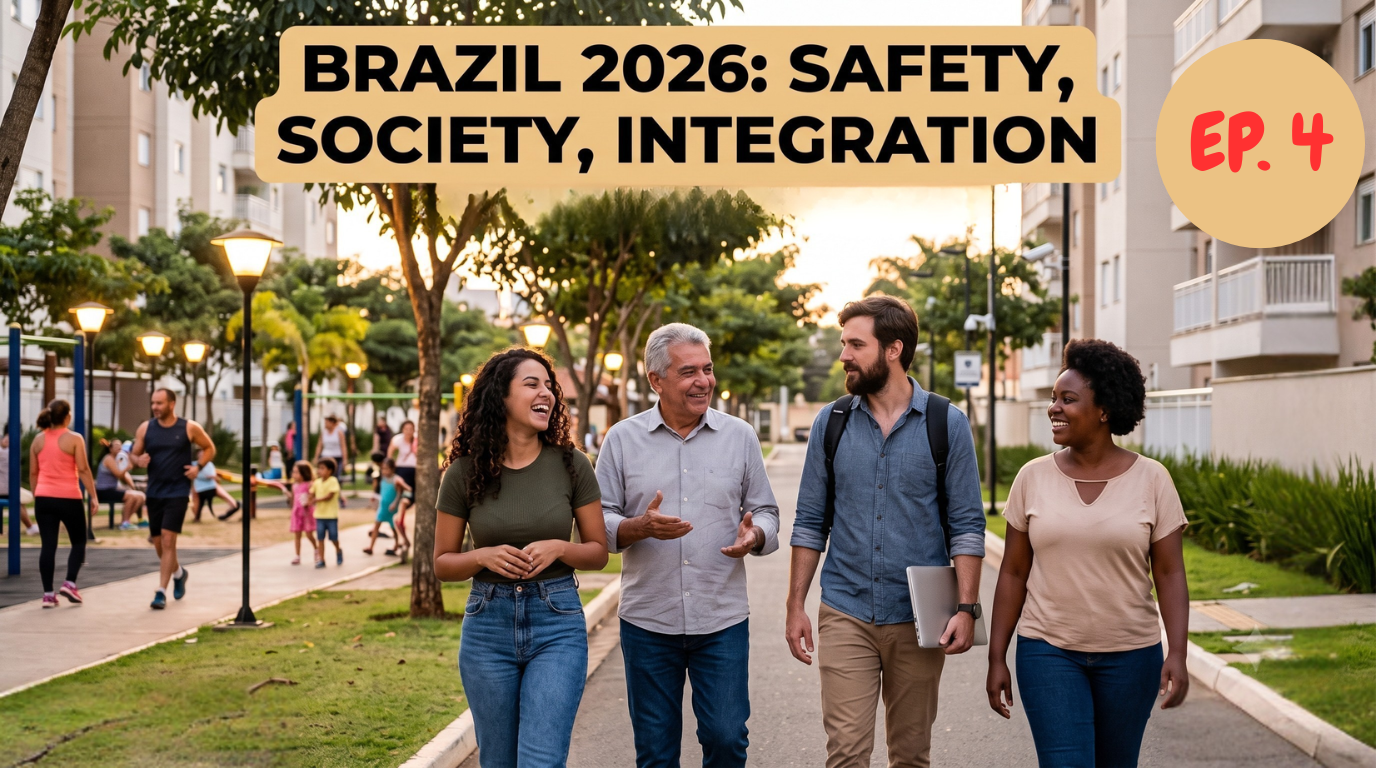
Safety, Society, and the Psychology of Integration
The final chapter of our deep dive into the cost and lifestyle of Brazil in 2026 is dedicated to deciphering the intangible yet crucial dimensions of the residency experience: structural public safety, the social fabric, and the complex psychology of integration required for those who wish to truly turn the country into a home
In 2026, the analysis of quality of life in Brazil moves away from old alarmist stereotypes to chart a narrative of consistent and cautious improvement
1. The Geography of Safety and Quality of Life
The perception of safety in Brazil is not homogeneous; it is deeply dictated by geography
Cities like Valinhos (SP) and Botucatu (SP) have become national benchmarks by recording extraordinarily low homicide rates, hitting historical lows of 0.9 and 1.4 occurrences per 100,000 inhabitants, respectively
Strategic Overview of Top Mid-Sized Cities (2026)
1st | Valinhos (SP): 0.9 homicides per 100k hab. / Strategic Edge: Capital of the Purple Fig; high-tech hub, close to the rapid expressways of Campinas, and high HDI
. 2nd | Botucatu (SP): 1.4 homicides per 100k hab. / Strategic Edge: Pioneering "Virtual Wall" project featuring smart AI-powered monitoring; major university hub (UNESP)
. 3rd | Brusque (SC): 1.5 homicides per 100k hab. / Strategic Edge: Strong community social cohesion, robust textile industrial tradition, and local full employment
. 4th | Jaraguá do Sul (SC): 1.7 homicides per 100k hab. / Strategic Edge: Extremely low incidence of property crime and a strong culture of community-based neighborhood watch
. The Scenario in Major Capitals: Urban Micro-segmentation
For those whose professional activities or cultural preferences require living in major capitals, the key concept to thriving is urban micro-segmentation
However, living in a large Brazilian metropolis in 2026 still demands mindfulness regarding opportunistic crimes, particularly smartphone thefts in public spaces
2. The Psychology of Integration and the Social "Cost"
The hospitality of the Brazilian people is widely recognized as a major global competitive advantage
💡 The Two-Year Rule: While the first contact is greatly facilitated by the expansive nature of local culture, transitioning from a "welcome visitor" to an "integrated member of society" follows a psychological timeline known among experienced nomads as the two-year rule
.
This 24-month period represents the average time required for a resident to move past the superficial initial charm, gain fluency in the Portuguese language, decipher complex governmental bureaucracy (such as dealing with the Federal Revenue and notary publics/cartórios), and establish deep friendships that extend beyond casual leisure
The Digital Nomad Visa, which requires a minimum monthly income proof of 1,500 USD, has solidified its position as the primary legal gateway into the country
In this context, learning regional Portuguese shifts from being a mere cultural hobby to a vital financial strategy
3. Monthly Budget Synthesis (2026)
Profile: Single professional demanding premium connectivity, high comfort, and enhanced security in dynamic metropolises like São Paulo or Rio de Janeiro
| Expense Category | Estimated Monthly Cost (BRL) | Structural Observations and Details |
| Rent & Fees | R$ 3,500 – R$ 5,500 | 1-bedroom apartment in a mid-to-high/noble neighborhood, including building maintenance fees (condomínio) and property tax (IPTU) |
| Food & Groceries | R$ 1,800 – R$ 2,600 | Mixed model including premium supermarket shopping and regular dining at mid-tier restaurants |
| Transportation | R$ 600 – R$ 900 | Intensive use of ride-hailing apps (Uber/99) and integration with the subway system. Avoids the fixed overhead of car ownership |
| Utilities | R$ 450 – R$ 750 | Electricity (highly sensitive to AC usage), water, piped gas, and high-speed residential fiber-optic internet |
| Private Health Insurance | R$ 400 – R$ 800 | Individual comprehensive health plan with national coverage in top-tier medical networks (Age group: 30-40 years old) |
| Leisure & Socializing | R$ 1,000 – R$ 2,000 | Active cultural life, dining out, weekend getaways, concerts, and premium gym membership |
| Recommended Total | R$ 7,750 – R$ 12,550 | Safety range to live with high comfort well-located in primary metropolises |
Conclusion of the Special Series
The cost of living in Brazil in 2026 reveals itself as a multifaceted mosaic, governed by geographic disparities and unique currency exchange opportunities
The key to successfully thriving in the Brazilian ecosystem lies precisely in balancing mathematical precision in budget management with an empathetic and open disposition to embrace the cultural immersion process
Comments
All comments are reviewed before publishing
Leave a Comment