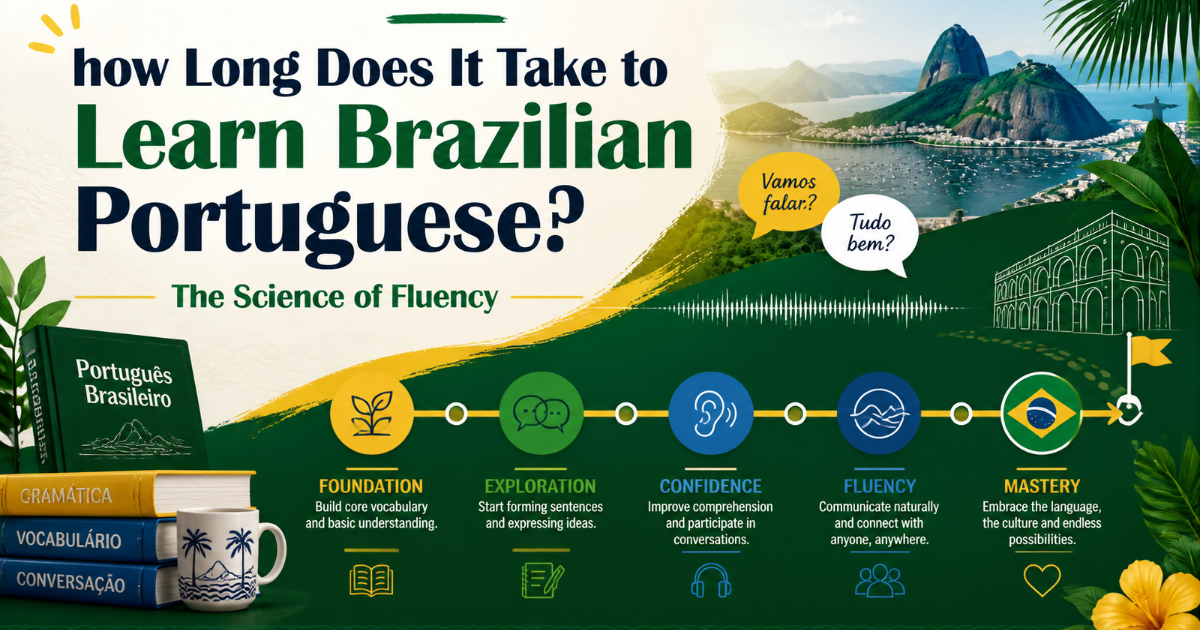
If you have ever heard someone describe Brazilian Portuguese as "Spanish spoken with music in the throat," you have already experienced the phonetic richness of Latin America's largest nation. Yet behind the musicality of open vowels and the syncopated rhythm of everyday speech lies a practical question that intrigues students, linguists, and diplomats alike: how long does it actually take to go from absolute zero to thinking, joking, and debating in Portuguese?
The short answer is that Portuguese is statistically one of the fastest languages to learn in the Western world. The long answer—and a far more fascinating one—involves neuroscience, evolutionary "shortcuts" between languages, and the quirks of a tongue that is rarely spoken on the streets the way it is written in textbooks.
1. The Diplomatic Clock: What FSI Data Reveals
The world's most reliable benchmark for language acquisition timelines comes not from a university, but from diplomacy. For decades, the Foreign Service Institute (FSI)—the U.S. government agency responsible for training diplomats for overseas posts—has monitored thousands of adult learners to measure exactly how long it takes to reach Professional Working Proficiency (equivalent to the B2/C1 level on the Common European Framework of Reference for Languages — CEFR).
The FSI divides the world's languages into four categories of difficulty for native English speakers. While Mandarin, Arabic, and Japanese sit in Category IV (requiring 2,200 hours of intensive study), Portuguese holds a privileged spot in Category I.
According to official FSI data, a dedicated student needs 24 weeks (roughly 600 to 750 classroom hours) to achieve professional fluency in Portuguese. For independent learners who aren't studying full-time like diplomats, that math translates into a clear learning curve:
30 minutes/day (Casual — ~180h/year):
Conversational Fluency (B1 - ~300h): 1 year and 8 months
Solid Fluency (C1 - ~650h): 3.5 years
1 hour/day (Consistent — ~365h/year):
Conversational Fluency (B1 - ~300h): 10 months
Solid Fluency (C1 - ~650h): 1 year and 9 months
2 hours/day (Intensive — ~730h/year):
Conversational Fluency (B1 - ~300h): 5 months
Solid Fluency (C1 - ~650h): 11 months
4+ hours/day (Full Immersion — ~1,460h/year):
Conversational Fluency (B1 - ~300h): 2.5 months
Solid Fluency (C1 - ~650h): 5 to 6 months
2. The "Cognitive Discount": The Advantage of Linguistic Distance
The FSI's 600-hour benchmark comes with a caveat: it was calculated specifically for native English speakers. In applied linguistics, the concept of Linguistic Distance—a metric popularized by researchers Barry Chiswick and Paul Miller (2005)—measures how structurally distant your native tongue is from your target language.
This is where the timeline shifts dramatically depending on a student's background:
The Romance Shortcut (Spanish, Italian, and French): The Ethnologue linguistic catalog notes that Portuguese and Spanish share an impressive 89% lexical similarity. Nearly 9 out of 10 words share the same root. Research on Romance language intercomprehension shows that a Spanish or Italian speaker can cut the FSI timeline in half (300 to 350 hours)—though they must watch out for the "Portuñol" trap, where the brain plateaus at an intermediate level simply because it can already make itself understood.
The Germanic Bridge (English, German, Dutch): Although English is a Germanic language, the Norman conquest of England in the 11th century injected thousands of French and Latin words into the English lexicon. An English speaker who has never studied a day of Portuguese already passively "knows" over 3,000 Portuguese words (for example, English words ending in -tion almost always become -ção in Portuguese: nation/nação, information/informação).
The Slavic and Asian Marathon: For native speakers of Russian, Mandarin, or Korean—languages that do not share this Latinate vocabulary or the same system of articles and verb tenses—the journey typically requires 800 to 1,000 hours, aligning with the upper end of academic estimates.
3. Why Brazilian Portuguese Is in a League of Its Own
When a foreigner decides to learn the Brazilian variant—spoken by over 215 million people—they encounter a fascinating phenomenon extensively studied by Brazilian sociolinguists like Marcos Bagno and Fernando Tarallo: Brazilian diglossia, or the wide gap between formal (written) Portuguese and vernacular (street-spoken) Portuguese.
Ironically, this distance between textbook rules and real-world practice makes Brazilian Portuguese faster to speak in the beginning, but trickier to understand at the intermediate stage. Here is why:
A. The Real-Life Grammatical "Relief"
In traditional grammar books, Portuguese features six conjugations for every verb tense (eu falo, tu falas, ele fala, nós falamos, vós falais, eles falam — I speak, thou speakest, he speaks, we speak, ye speak, they speak). In everyday life across most of Brazil, the pronoun "tu" has largely been replaced by "você" (you), "vós" has vanished entirely, and "nós" (we) is frequently swapped in conversation for the expression "a gente" (literally "the people," used to mean "we")—which takes a third-person singular verb ("a gente vai" instead of "nós vamos" for "we go").The impact on your timeline: A beginner in Brazilian Portuguese can build natural sentences in the present, past, and future using just 3 main verb forms (Eu, Você/Ele/A gente, and Eles), drastically accelerating spoken fluency during the first 50 to 80 hours.
B. The Listening Challenge: Syllable-Timing and Nasal Vowels
Unlike European Portuguese (which is a stress-timed language where speakers "swallow" unstressed vowels, making listening comprehension notoriously tough for beginners), Brazilian Portuguese leans strongly toward being syllable-timed. Every syllable is pronounced clearly and with open vowels, which is a massive gift to a beginner's ear. However, Brazil holds two phonetic hurdles: nasal vowels (pão [bread], mãe [mother], manhã [morning]) and the phonetic reduction of rapid speech. In a lively conversation, "Você está esperando o ônibus?" (Are you waiting for the bus?) instantly morphs into "Cê tá sperando o ônibus?". Decoding these natural contractions is the primary milestone that separates the 200-hour mark (B1 level) from the 400-hour mark (B2 level).
4. The Math of Words: How Many Do You Actually Need?
Corpus linguistics studies—pioneered by renowned researcher Paul Nation (Victoria University of Wellington) and applied to Portuguese by linguist Mark Davies (author of A Frequency Dictionary of Portuguese)—reveal that you don't need to memorize an entire dictionary to become fluent. Languages follow Zipf's Law: a remarkably small group of words does almost all the heavy lifting.
The first 1,000 most frequent words in Portuguese cover roughly 80% of any everyday conversation.
The top 3,000 words cover an impressive 90% to 92% of general texts, movies, songs, and dialogues.
5,000 words place a learner in the 95%+ comprehension bracket—the threshold where the brain can effortlessly deduce the meaning of unfamiliar words purely from context.
By actively learning just 10 new words a day, a student can build the lexical foundation for fluency in under 10 months.
5. How to Hack the Time Curve, According to Science
Why can two students with the same native language take either 8 months or 3 years to reach the exact same level of Portuguese? Cognitive science points to three proven accelerators:
The Comprehensible Input Hypothesis (Stephen Krashen): Research shows that fluency isn't born from memorizing verb charts, but from massive exposure to content you already understand at a 70% to 80% level (podcasts, Brazilian shows, MPB or Bossa Nova music, and real conversations). The human brain is a pattern-recognition machine; feed it enough audio and text, and grammar consolidates naturally.
The Spacing Effect (Spaced Repetition): Discovered by German psychologist Hermann Ebbinghaus, research on the "Forgetting Curve" proves that studying for 45 minutes every day yields up to twice the synaptic retention of cramming for 5 hours straight on Saturdays. The brain consolidates language structures during REM sleep between study sessions.
Early Spoken Output (Merrill Swain's Output Hypothesis): Students who start speaking with native speakers or tutors from week one—even while making mistakes—activate motor and syntactic processing areas in the brain that silent reading never touches, cutting the path to a B2 level by up to 30%.
Sources and References
For readers interested in exploring the scientific and statistical data cited in this article:
Foreign Service Institute (FSI) – U.S. Department of State: Foreign Language Training – Language Difficulty Rankings. Official classroom-hour benchmarks for professional proficiency in Category I languages.
Davies, Mark & Preto-Bay, Ana Maria Raposo (2007): A Frequency Dictionary of Portuguese: Core Vocabulary for Learners. Routledge. (Corpus study on the frequency of the 5,000 essential words in Portuguese).
Nation, I.S.P. (2006): "How Large a Vocabulary is Needed for Reading and Listening?" The Canadian Modern Language Review, 63(1), 59-82. (Foundational research on lexical coverage and fluency).
Chiswick, Barry R., & Miller, Paul W. (2005): "Linguistic Distance: A Quantitative Measure of the Distance Between English and Other Languages". Journal of Multilingual and Multicultural Development.
Bagno, Marcos (2007): Nada na Língua é por Acaso: Por uma Pedagogia da Variação Linguística [Nothing in Language is by Chance: Toward a Pedagogy of Linguistic Variation]. Parábola Editorial. (Sociolinguistic analysis of the real-world differences between spoken Brazilian Portuguese and standard written grammar).
Council of Europe (2020): Common European Framework of Reference for Languages (CEFR): Learning, Teaching, Assessment. Cambridge University Press. (Estimated study-hour guidelines across proficiency levels A1 through C2).
From Theory to Fluency: The "Lean Approach" to Brazilian Portuguese
Understanding the science behind language acquisition is the first step, but turning research into real-world conversations requires a system that eliminates wasted effort. Traditional courses and apps force you to memorize archaic conjugations and low-frequency vocabulary before you ever form a single natural thought—turning a 600-hour journey into years of frustration.
After years of hands-on practice guiding international students from absolute zero to confident fluency, Luiz engineered the Lean Approach—a practical, results-driven methodology built on the exact synthesis of the three cognitive accelerators explored above:
Curated Comprehensible Input (Krashen’s Hypothesis): Instead of drowning in endless grammar rules and obsolete textbook dialogues, the course immerses you in the high-frequency vocabulary, authentic audio, and real-world vernacular that power 80%+ of everyday Brazilian life.
Strategic Spaced Consolidation (Ebbinghaus’s Spacing Effect): Every module is structured into focused, high-retention blocks that work with your brain’s natural memory curve—allowing you to lock in vocabulary and the three core Brazilian verb structures without burning out.
Guided Early Output (Swain’s Output Hypothesis): From your very first lesson, you are challenged to actively construct sentences and speak out loud, rewiring your brain to think, react, and express yourself in Portuguese without translating in your head.
Fluency doesn't happen by accident, and it doesn't require years of tedious memorization. It happens when you combine proven linguistic science with a streamlined, battle-tested method designed by an experienced educator who knows every shortcut—and every pitfall—of the Brazilian language.
Ready to cut your learning curve in half and start speaking real Brazilian Portuguese from day one?
Join the course at https://www.portuguesewithluiz.com/ and experience how Luiz’s Lean Approach turns the science of language learning into your fastest, most direct path to fluency.
Comments
All comments are reviewed before publishing
Leave a Comment