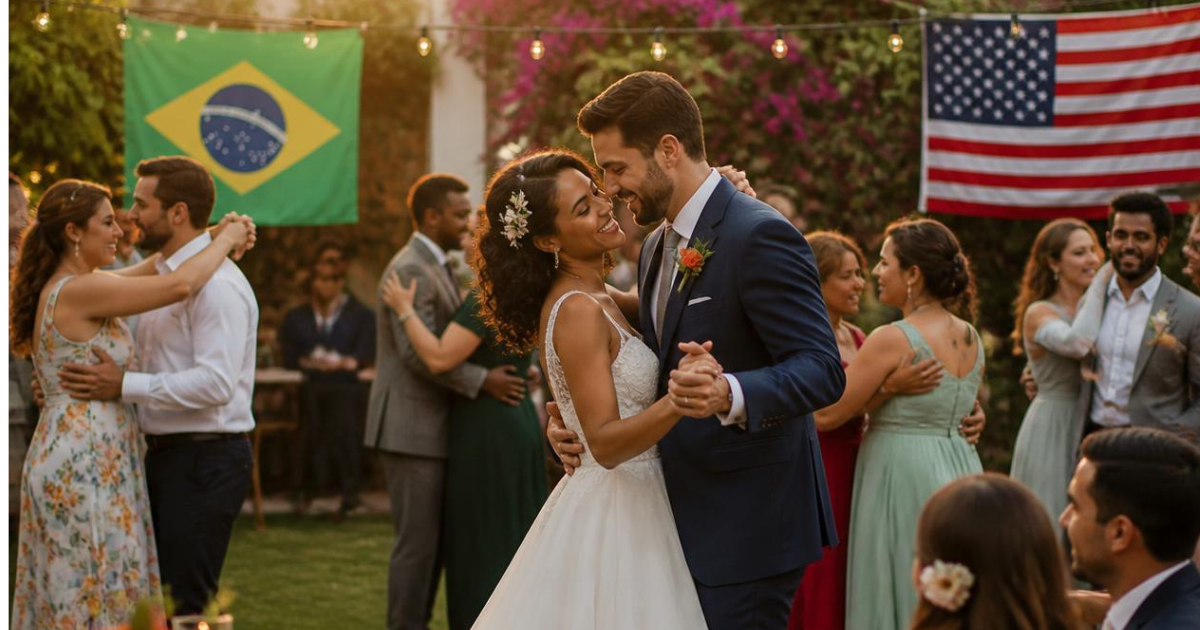
Marrying a Brazilian is the first step toward building an international life together, but understanding the rules of the game is essential so the dream does not turn into a bureaucratic nightmare. We—Luiz and Rebekah—are going through this exact phase right now: making decisions, tackling paperwork, and navigating the bureaucracy to make our union official. In this complete guide, based on both the law and our own real-life experience, you will discover the smartest path to tie the knot, from choosing between Brazil and the US to the secrets behind apostilles, visas, and the hidden costs no one tells you about.
The Shortest Path: Getting Married in Brazil or the US?
The golden question for every binational couple is where to hold the wedding. There is no single answer, but rather two routes with entirely different timelines and rules.
If the ultimate goal is to live in the US, you have two main options. The first is the Fiancé(e) Visa (K-1): the American citizen petitions for the Brazilian partner, who travels to the US to get married within 90 days. This process can take over a year just for pre-approval. The second route is the Spousal Visa (CR-1): you get married first in Brazil (or another country) and then apply for the immigrant visa. The CR-1 can take 12 to 18 months, but the Brazilian spouse arrives in the US with a Green Card in hand.
For us, as for many couples, getting married in Brazil is the fastest and most accessible path for the civil ceremony itself, besides immediately paving the way for the American partner to apply for residency in Brazil.
Cartório Bureaucracy: Apostilles and Translations
If you decide to get married in Brazil, get ready for a paperwork marathon. The American citizen will need to present a passport, an original birth certificate, and a declaration of civil status.
The golden rule is: no American document is valid in Brazil without a Hague Apostille. The apostille must be issued in the United States. Once in Brazil, these apostilled documents must undergo a Sworn Translation (Tradução Juramentada) performed by a certified Brazilian public translator.
An insider tip and a hidden cost: If the American partner does not speak and understand Portuguese fluently, Brazilian law requires you to hire a sworn translator on the day of the wedding to translate the civil registry (cartório) ceremony. This is where we have a massive advantage in our journey: Rebekah already takes the PWL (Portuguese With Luiz) course and is fully capable of expressing herself, understanding, and interacting at the cartório (and in any other everyday situation in Brazil). This not only saves us a fee that can easily top $100 to $200 USD, but it also makes the moment infinitely more special and authentic.
Visas, Timelines, and Travel Freedom (CRNM)
When planning a life together, residency rules are what impact a couple the most.
If you opt for the K-1 Visa (getting married in the US), after the ceremony, you will need to apply for the Adjustment of Status for the Green Card. During this period, which can take nearly a year, the Brazilian partner cannot leave the United States (unless they receive a special authorization called Advance Parole). Leaving early cancels the process.
In Brazil, the rules are much more flexible. After the cartório wedding, the American citizen can apply for Residency based on Family Reunion directly with the Federal Police. The process of issuing the National Migratory Registration Card (CRNM) can take anywhere from 15 to 120 days. During this review period, the Federal Police issues a protocol that serves as a temporary official document.
Can the foreigner leave Brazil while waiting for the CRNM? Yes! Unlike the temporary "lockdown" of the American Adjustment of Status, the Federal Police protocol proves that the foreigner is legally in Brazil. With this protocol and a valid passport in hand, the American has the freedom to travel abroad (to visit family in the US, for example) and return to Brazil without jeopardizing the residency process, as long as it does not constitute a permanent abandonment of the country.
Key takeaways
Getting married in Brazil is usually the fastest route for the civil ceremony, requiring a Hague Apostille (done in the US) and a Sworn Translation (in Brazil) for all foreign documents.
The K-1 visa keeps the foreign partner in the US during the Adjustment of Status, while in Brazil, the Federal Police protocol allows the American to travel abroad while waiting for the physical CRNM card.
The foreign partner who does not speak Portuguese is legally required to pay for a sworn translator for the Brazilian cartório ceremony.
Learning the language eliminates these extra fees and gives the foreigner complete independence.
The Next Step for Your International Marriage
Visa paperwork, cartórios, and certificates are just the first practical challenges of uniting two cultures. For us, and for any binational couple, true success lies in daily communication and independence. If your partner needs a translator just to say "I do" at the registry office, imagine the difficulty of navigating life in a new country.
Rebekah is already prepared to face any situation in Brazil because she decided to break the language barrier. Do not let communication be an obstacle in your life together. The best way to ensure a smooth and independent transition for your American partner is by mastering the local language.
Prepare your documents, plan your future, and take the most important step of all. Join the complete Portuguese With Luiz (PWL) course today and transform the love of your life into a confident speaker, ready for life in Brazil.
"The K-1 visa locks you down in the US for months, but the process in Brazil lets you travel. Which path did you choose for your relationship and why?"
Comments
All comments are reviewed before publishing
Leave a Comment